
“It takes 17 muscles to smile and 43 to frown.” ~ Unknown

Obviously it is a lot less stressful to smile.
Happiness is infectious – go and infect somebody with a smile.
Here is my smile to you.

“It takes 17 muscles to smile and 43 to frown.” ~ Unknown
Obviously it is a lot less stressful to smile.
Happiness is infectious – go and infect somebody with a smile.
Here is my smile to you.
It certainly looks like an elephant’s leg. It may feel like an elephant’s leg, and in my mind this large beech tree could well be an elephant’s leg.
Following these random thoughts I decide to relax for a while and sit in the dry leaves with my back against the impressive trunk (no pun intended). I gaze up into the bare branches and, rather like Alice, disappear down a rabbit hole in my mind.
We visit many properties during our working year. On all we apply the same degree of skill and effort to create something that will meet the approval of our clients. However, some gardens are happier places to work in than others. As I ponder the elephant’s leg conundrum the idea that some gardens are less than happy places to work in begins to disturb me, so I decide to delve a little deeper.
In order to fathom the thought I order some of my gardens into ‘happy’ ‘just so’ and ‘this won’t do’ categories. The ‘happy’ gardens are ones where I often relate more closely with the client, but more importantly they are gardens where I can get in and scrimmage around. On warm dry days it is almost like going for a day out with close friends. I don’t talk to the plants like Prince Charles, but I do empathise with their situation. Being a touchy/feely sort of gardener I allow my instincts and powers of observation to notice when a plant looks distressed. My gardens dictate to me, and I listen. These places are proper gardens to me because I can experience the flow and get in sync with the garden holistically. They thrive and blossom, as long as they are fed a well balanced diet and adequate moisture. They are full of insects, birds and small invertebrates. These thoughts have the Bambi effect in my mind, Disneyesque butterflies and singing bluebirds…stop it.
The other category is more unsettling for my curious mind. It becomes clearer as I consider why. Invariably mankind seems determined to live on the edge of perpetual disaster. Many want to mould and manipulate things to suit their needs or to garner profit. Clearly we all need to survive to perpetuate the species, but at what cost?
Gardens in the ‘just so’ category are the ones where my clients want me to dominate the plants, to structure their gardens and make every blade of grass and flower look perfect, last longer and grow in the classic manner. In other words they want me to control the situation and force the plants to grow in violation of a natural law. Let’s face it, a privet tree is not long and rectangular, a willow leaf pear is not naturally a toffee apple shape. Indeed a willow leafed pear, allowed to grow to maturity, is a magnificent specimen with gorgeous silver leaves that drape down to the ground and produce lovely fruit, so why is it fashionable to trim it? Topiary is admirable in a strange way, but I avoid trimming as much as possible. Pruning for health seems far more appropriate to me.
Sometimes in these gardens we feel as if we never notice the beauty because we are too busy trying to create it.
The latter category ‘this won’t do’ is easier to understand. On occasion I have had disagreement with clients over what they expect from us. These people are the ultimate control freaks and expect the rest of the world to tug on fetlocks far too much. I have boundaries where I refuse to cross in the care of a garden. I also have boundaries with the way I want clients to treat my employees. The process is simple. ‘Thanks for giving us the opportunity to work on your garden, but we have far more important jobs to attend to. Sayonara.’ I never feel sad about losing one of these projects.
This brings me to a conclusion.
In the comfy rabbit hole of my mind I realise, of course, that natural is best. Nature will assert itself with just a little help from me, and hopefully have a very contented existence under my care.
The second option, also acceptable but definitely my second choice, is that ‘just so’ is actually a Zoo for plants. Plants in the ‘just so’ properties are put in confined spaces, are not allowed to mingle, are force fed diets of chemicals, are expected to hold tricky postures like a street artist in Barcelona. They are confined indoors for winter, starved or force fed to allow flowering at inappropriate times and have to endure haircuts once or twice a week, never to reproduce. Plants have their young taken from them (seeds) and distributed to other parts of the world, put up for adoption.
However, the true Zoo analogy relates to the attitude of the garden owner. In an animal zoo we wander around on paths, look at the creatures in cages or occasionally in safari type reconstructions. Yet we aren’t allowed to go and touch unless it is a petting zoo. We all love to see the exotic creatures, just as we love to see exotic flowers and plants. ‘just so’ owners want their gardens to be artificial so that they can gaze on contentedly and know that their regime has been imposed on the plants. They offer raised eyebrows when asked simple questions such as. ‘Do your plants enjoy being overcrowded?’ ‘Would your plants prefer to live in a sunny climate?’ ‘Do you overfeed your children so that they can win awards?’
Are these ‘just so’ garden plants happy? Is it appropriate to create garden Zoos for our own titillation?
My phone will be running hot now with clients who think that they may be one of the ‘just so’ gardens. Don’t worry folks, this was just a dream as I rested comfortably against the huge leg of an elephant, and gazed up into a large squirrel hole.
The silky warm water caresses my legs then hisses back down the slope.
This tropical soup that passes for the Coral Sea is fed by brown sludge from the rain swollen rivers of North Queensland. It is penned in against the coastline by the Great Barrier Reef, the ruddy brown colour seems out of place, surely you would expect crystal clear water, tropical fish and vibrant coral.
I half raise myself onto my elbows and narrow my eyes against the dreadful thrumming headache and glare of the powerful sun. After drinking far too much Stone’s Ginger Wine, and some gasping bilge that passed for rum, I am suffering as the heat intensifies, my throat is parched. My mouth feels as if somebody has ripped out my tongue and replaced it with a bath sponge. Why do I drink so much? Leonie is clearly suffering equally but lights up her first ciggie of the day.
‘How can you do that?’ I hear myself croak. My voice resonates inexplicably from my sinuses.
She coughs, winces and turns her head to gaze over the seething chocolate water. Another smooth wave cruises up to the slope, smushes down into the sand then washes froth up to her toes. ‘Because Johnno, I am an Australian and my mother’s milk was blended with alcohol. You, on the other hand, are a soft Pommie bar steward raised on milk from herds of fat, docile Jersey cows.’
Nonchalantly flicking the ash away from her knee, she draws hard, plumes the smoke in my direction and adds. ‘In other words, toughen up your act or you will be getting on the next boat back to the Motherland. Aussies just cope better. What’s more.’ Pausing for effect.’We own the Ashes.’ Leonie knows how much I hate being called a Pommie, and loves it when I am tormented by the Aussies about our supposedly inferior cricketing nation. They think they own the ashes, those precious burnt bails.
I flop back onto the sand, exhausted and incapable of any meaningful debate.
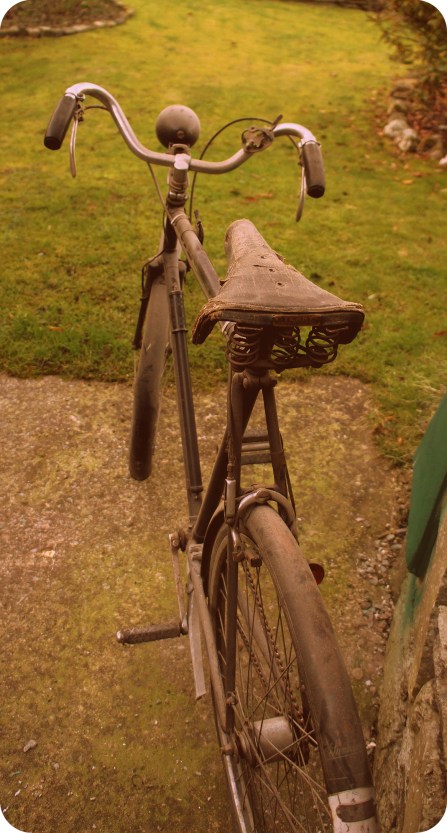
Sit Up And Beg bicycle. Lovely bike full of character.
We had ridden hard the previous afternoon to get to Turtle Cove before sunset. Our vintage sit-up-and-beg bikes held up well. I had been cleaning and oiling them, pumping up the tires and studied the map carefully. Turtle Cove was about 30 miles from Cairns and seemed to be perfect for our expedition, we craved a wilderness experience. From what I could deduce Turtle Cove had no houses, was miles from anywhere, had rocks on the beach and a stream flowing out of the jungle that looked to be pristine. Perfect location.
Once we set off from Cairns we quickly established a rhythm. The old bikes only had 3 gears, crumbling brakes and tattered saddles that nipped at the nether regions, but we were full of determination. Our previous ‘best’, Ellis Beach, was left behind, on we rode into virgin territory. We became possessed with a metallic tang of anticipation for our trip.
I found myself mumbling, ‘Appreciate it all, don’t miss a thing. Pedal, look, pedal, look. Appreciate it all, don’t miss a thing.’ The road surface was kind with only slight rise and fall, we began to power on, both locked into our own world where we filched through private thoughts.
We did stop once to grab a couple of cold drinks from a touristy stall. Australia is a great place for healthy food and drinks. We both had freshly squeezed fruit smoothies and a handful of our home-made ‘scroggin’ mix.
Imagine our delight when we reached Turtle Cove. Nobody there, nothing on the beach except a few pieces of bleached flotsam. A beautiful stretch of natural undisturbed paradise. We both quietly dismounted, dropped the bikes beside the road and made our way to the sand. No path led down so we had to push through some scrub. The sand was fine and deep, we tossed off our trainers and luxuriated in the cool texture as it accepted our feet. At the water’s edge we simply stood with the water washing up to our knees, grinning like two fools. Turtle Cove, our Paradise Beach.
We brought our bikes down, found a spot to camp, collected wood for a fire before night fell and organised ourselves to enjoy the treats brought with us. After boiling a billie and eating our supper we cracked open the grog. We slowly drank the bottle of Stone’s Ginger Wine, it made us euphoric, sitting in a tropical night under a vast sky that seemed to envelop us. It was so close that we could reach up and touch the stars. We laughed and talked endlessly, the conversation becoming totally forgettable after the bottle of rum had been drained. We washed the wine bottle in the surf, wrote a message with a promise to pay the finder a pot of gold, capped it and tossed it far out onto the sea. We hoped that somebody would find it on an icy cold day in Alaska, open it and smell the beauty of this tropical night.
The new day was progressing and I wanted to make the most of it.
‘Leonie. I need to get a brew going. It would be good to eat something to line my gut too.’
‘Ok Johnnyboy. Stoke up the fire, I have to visit the ladie’s room.’
I manage to pick myself up, distinctly queasy I find some more wood to resurrect the fire. Good fires always relight the following day without much fuss. Sinking to my knees I break the twigs and arrange them in the embers. Before long tiny streamers of smoke rise and I introduce large twigs, confident that the fire will burst open soon enough. Gathering the empty billy I move across the road and dabble in the small pools of the stream. I splash the cool water onto my face, it feels good. In my delicate state I stop frequently to mull over vacant thoughts, content to let my eyes see without thinking too much. The water is clear yet full of life, fascinating. Eventually I fill the billy and head back.
It irks me as I realise that I forgot to pack any medication. So we have no painkillers to help quell the headache. I pride myself on being organised, this is a silly oversight.
Leonie is arranging things for our lunch. She is a vegetarian and has to put a great deal of thought into food to make it tasty. She had brought tabouli, falaffel, a hard goat’s cheese, chutney, avacados, lots of salad and a handful of fresh herbs. She creates sandwich fills for pitta bread. We take our food over to the rocks, hop out to the larger ones in the water and enjoy our meal. After several doses of tea we are ready to crack on with our adventure.
We intend to follow the stream up into the jungle. We know there is no path, and that is the best part, a proper adventure, to go where no man has gone before! Well it will feel like that to us.
‘I am going for a dip before we set off. It will freshen me up a bit more.’
I rush down to the water and dive in. It feels great, I am reluctant to open my eyes under water because of the murk, so swim with my eyes tightly closed and surface when my breath starts to run out. It isn’t very deep because I can feel the sand under my feet as I kick. I stand up, the water to my waist, flick the water out of my hair and draw my palms over my face to sweep away the saltwater. What feels like a blob of sticky jello is in my hair so I try to flick it off, then push my hand into the water to rinse it away. With a sharp intake of breath I notice that I am standing in the middle of a ‘flock’ of bluebottles and the jello is actually a tentacle. I begin to feel the stinging in my fingers and on the back of my hand. Oooops!
‘Don’t come in the water Leonie. There are bluebottles all over the place.’ She stands, hands on hips, at the waters edge immobile.
My hand is hurting a little now and I need to get out. ‘Try to find something like vinegar to put on the stings. It isn’t a problem but it is hurting. Isn’t it vinegar that works on these stings?’
She glares at me and runs up to the tent. ‘Get out of there quick before you get stung somwhere else that might hurt your paler parts of your body a lot more than a twinge on your hand.’
I look around and see that I am more or less on the edge of the ‘flock’. Picking my way carefully I go back to the beach where Leonie has a small tube of Sting Relief. The jello has gone but there are angry looking welts and an emerging rash around the back of my hand and inbetween some fingers. She smears plenty of the cream on my skin, there is almost instant relief.
‘There you go Johnnyboy, you owe me another one! Lucky that I though to bring a first aid kit.’
I mutter grudgingly. ‘Yeah yeah, you Aussies are super stars. Only problem with this place is the dangerous wildlife, it looks very pretty but packs a heck of a punch. Typical Aussie.’
_______________________________________________
Next issue: Up the Jungle
Can we ever know when the moment is ripe and we are about to embark on something epic?
Perhaps you have a dream that you feel can become reality. More often than not it will remain a lovely dream. From time to time we all set out with determination to achieve something, take a few steps before other issues arise and deflect us from our goal. The future for everyone will remain a mystery, no matter how carefully we prepare there can be no certainty of the outcome.
Throughout my life things seem to have just ‘happened’. I firmly believe that you should follow your heart and the future will take care of itself, but don’t quote me on that, I am sure there are lots of people who disagree.
Heather and I had been walking in the English Lake District, occasionally reaching the summit of notable hills. There had even been semi-serious banter of walking the Wainwrights. It took me 20 years to ‘do’ the Wainwrights and I hankered to walk them again with Heather. However most of our walks had been tempered by Heather’s fear of heights, vertigo seemed to grasp at her randomly, we frequently aborted the more difficult sections. Sometimes it bamboozled me how the attacks developed. Crossing a stream via stepping stones could generate an anxiety attack, once the seed was set her mind could interpret minor green slopes as the North Face of the Eiger, we would turn back. She was fit and accustomed to walking, but only at low levels. Heather has something in bucket loads, determination, she insisted that we continue to walk regularly and conquer the wobbly demon.
Hillwalking, mountaineering and rockclimbing have always been my passion. Memorable days on the hills continue to live as jewels in my mind, I so wanted Heather to experience something similar. Getting a natural ‘high’ on a mountain, for me, is one of life’s essentials. Most of the time I would walk solo, quickly getting into the flow of a walk. As the last gate to the fell closed another less tangible gate would open up in my head. My eyes would scan the path ahead, then the slopes and the skies. I learnt how to look into the distance, how to feel at home in all weathers, and how to become one with my body and the mountain. Every walk was epic for me, it delighted me to use my body and savour every moment, my senses on alert. I learnt how to be sure footed and agile. I learnt how my muscles and tendons functioned under pressure, and learnt how to relax during prolonged periods of strenuous walking. It would be an entirely different challenge to encourage Heather.
I pondered various options, most of them unlikely to improve the situation and decided to add the incentive of completing the Dales Way, an interesting long distance trail approximately 80 miles. I had walked many sections with my children when they were small, so anticipated that Heather should have little difficulty and the sense of achievement would build confidence allowing us to attempt progressively adventurous walks.
The following articles break our walk down into day sections, the majority were completed on a Sunday, occasionally we would walk both Saturday and Sunday. A healthy, moderately fit person can complete this epic and hold down a regular job, but don’t blame me if the bug bites and you feel the need to plough on, once started this walk will draw you in and on. The whole journey is on footpaths or bridleways avoiding civilisation as far as possible. It will be possible to select a day walk at random or if you feel so inclined attempt to walk the whole journey from beginning to end, be warned, we have covered almost 1,400 miles of continuous linked walking and have a long way to go. I have an end in mind, but all endings are simply the beginning of something else.
Should you decide to attempt any of the walks, please be sure to take adequate food, appropriate clothing and footwear, inform somebody of where you will be walking, when you intend to return, carry a map, compass, whistle, torch and phone. Above all, take your time, this is a journey to be savoured.
If you walk quickly you may catch us up!
Good luck. John
Like any addict once the lure of the silver spoon strikes it is virtually impossible to resist, similarly the kick of travel and adventure has one mighty compelling high.
At the peak of my travel addiction I would have donned flippers and mask in a heartbeat if somebody had asked me to swim to Tahiti. Life was a surging rush and I wanted to be soaked in every possible way.
In Cairns, after deciding to stay in Australia rather than head off to Papua New Guinea, we needed to perpetuate the dreamtime we had been living on Green Island, yet we had little money to support our fantasies. Our new found jobs were providing us with a little surplus, barely enough to plan a major adventure. Talented Leonie came up with a solution, wondering if we could create leather goods to sell at the Sunday market to boost the coffers for another travel fix. I had been mainlining on travel for so long that the withdrawals were like a gnawing ache, she didn’t have to ask me twice, I needed a fix.
We figured out a way of making bespoke sandals from hides, bought some cheap hides and a few handtools, traced around our feet to get the general shape and proceeded to cut out the soles from the thicker parts of the hide. Great ideas often come in tsunami format, so once the entrepreneurial lid was lifted we were ready to sell our leather goods internationally.
Of course that never happened, but we did benefit from several interesting days on the Cairns Sunday market selling our stuff. We managed to break even and met loads of other Bohemianesque bodies. However, the greatest discovery at the market was a stall selling secondhand household goods. One Sunday I wandered over while Leonie was selling ‘stamped’ purses and beaded leather bracelets. At the back were two butcher’s bikes, both dull and rusty but with tyres and a semblance of brakes. Instantly I fell in love, swirling dreams of leisurely cycling into the sunset or laughing like hyenas as the bike bobbled down a grassy slope, Leonie in the front carrier, until we fell off into the wavy grass. (Or was that a scene from Butch Cassidy?) I bought them both for a few dollars and proudly walked my new travel facilitators back to our stall.
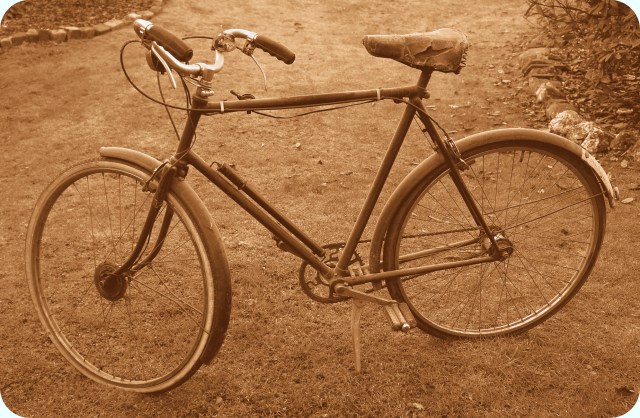
Bike bought on Cairns Sunday market for a few dollars.
We never went back to the market. When we managed to get a few days together we would pack up our gear, load it into the front baskets and set off from work, often pedalling up the coast from Cairns toward Port Douglas.
It didn’t matter how far we pedalled. What did matter was being able to get a dose of that travel syrup. Our early journeys, until we could trust the old bikes, were gentle meanders around Cairns, we stopped frequently to investigate things. We rode slowly to absorb it all and let the immense variety and beauty seep into our souls.
Once we were riding with open fields to our left when I spotted a hedgehog in the grass. A hedgehog? Long slow squirl as the mouldy brakes nibbled a catchy tune on the wheel rims. Dropping the bike I loped back to the dark hedgehog like lump with a curious elongated nose.

In the spotlight.
‘Leonie, come and have a squiz at this.’
Completing a 360 in around 5 minutes, one foot tapping the road, she wiggled her loaded butcher’s bike to a halt. Leonie’s bike had a narrower front wheel which looked a bit dodgy on the point of separation from the rest of the bike. In truth it barely functioned unless treated with extreme kindness.
‘What do you reckon to that? Is it an echidna?’
‘Well. I guess it is. Not sure, never seen one before.’
Leonie was full of hippie knowledge, a converted Bohemian, self-styled nouveau-Aussie-townie who knew everything about making dried potatoe into colourful jewellery. She had a penchant for extracting juice from dandelion stems and pressing fresh flowers. Her other mind juggling skill was creating astrological charts crammed with mysterious witchlike signs. Indigenous flora and fauna were a shade alien to her nebulous thought pattern.
After scouting out the local terrain we began to hanker after a bigger challenge. We bought a road map and realised that a little further up Captain Cook Highway were long ribbons of palm fringed beaches. Ellis Beach became our prime target, a short journey from Palm Cove, practically a suburb of Cairns.
Ellis Beach was quite startling because we didn’t expect to find a mini tourist haven. We had set off early one Saturday morning, pedalling much harder than on previous trips. Our objective was to use the bikes purely for transport then spend time camping on the beach, lazy swim and wander around on foot before we had to head back to Cairns on Sunday. After leaving Palm Cove we pushed on steadily, enjoying the birdlife and smelling the ocean off to our right with a seemingly constant strip of inviting sand. It felt good to be extending ourselves.

Saddle sore? You bet!
This was our longest ride to date and our backsides were feeling a little sore in the bucket like saddles, so we decided to stop at a slight rise on the highway with good views out to Double and Haycock Islands. Enticing places that appeared attainable by small boat.
‘Hey Leonie. Perhaps we should buy a rowing boat? It would be ace to go out to those islands and camp there.’
Leonie was used to this kind of speculation. ‘Dream on Johnny Boy. Are you going to tow the bloody boat at the back of your butcher’s bike?’
She was equally familiar with my responses. ‘Mebbe! Give me a little more time with this idea.’
‘Crazy Pommie bar steward!’
We slaked our thirst with some curious concoction Leonie made from pomegranates, lemons and purified water. What on earth is purified water? Water is water, it pours out of the sky by the lake load, surely that is as natural and purified as it needs to be.
Refreshed we mounted up again and pushed on. Very shortly, round a smooth curve in the road it rapidly became obvious we were coming to Ellis Beach. Actually there was a sign that said … Ellis Beach.
The map showed virgin beaches in this area, imagine our amazement as homes appeared amongst the trees. Many with corrugated tin rooves, verandahs and pretty gardens alongside burger bars and ice cream booths that wouldn’t have been out of place on a spaghetti Western set. The giveaway sign that we were in tourist town were the beach wear shops, selling the usual bucket and spade mish mash. Family groups laden with towels were skipping across the road, older folk carrying umbrellas and foldaway canvas chairs made their way to the beach. Teenagers with eskies and tanned surfer boys with packs of Fosters joked as they kicked up the sand. Music was already blarting out from a rudimentary beach bar.
We stopped in the midst of it all, legs straddling the bikes, nodded disapprovingly through stiff smiles then kept on riding. Ellis Beach was a long development with a lovely beach but wasn’t for our free radical, Bohemian sense of adventure.
Tired and disgruntled we needed to stop. Once out of the busy beach atmosphere we decided to find somewhere nearby to pitch up for the night. The silky beach had given way to a rougher aspect but we still found a place to pitch our tiny tent, stash the bikes and go for a swim to replenish our skittered spirits.
The following weekend we determined that finding utopia would require greater effort to bust past dystopia and find our Shangri La. Next target was a whopping 60 mile round trip by butcher’s bike – Turtle Cove.
Occasionally, as my mind veers toward a random moment, vivid images from my past rear up and I allow myself to luxuriate in the memory. I have noticed that sense of smell has played an enormous part in the strongest of memories. In fact, as I mull this over, sense of smell has been fundamental in all intense events of my life.

Viola Sold Bread
A few months ago I took one of my children, Rachel, back to the village where I was raised. A hamlet near Skipton in what was the West Riding of Yorkshire. With a tiny population of 700 it was impossible to be a recluse, a number of families, including mine, had lived in the village since the end of the last Ice Age, so I was told. The family had always lived in Plum Tree Cottage, a delightful place which seemed to me, an enormous property, always full of relatives, friends, dogs and the aroma of the ‘hanging pot’.
The ‘hanging pot’ was essentially a witches cauldron, left permanently hanging on a large swinging hook by the fireplace. Any surplus food that came into the cottage was lobbed into the pot to stew, anyone who felt hungry would dip into the pot and eat. Whenever I walked through the door I could tell what was in the pot, the smell of rabbit or chicken, onions or carrots, simmering seductively and always a temptation. If I visited after school I was always given a bowl to fill and a lump of fresh bread to sop up the juices whilst sitting on a stool by the fire. Great Auntie Lilian was the matriarch, she had several sisters, Edith, Monica, Cissie, Sally and, youngest by far, Viola who were frequently in the house. I can distinctly remember one occasion when Monica and Cissie were visiting, the three ladies were preparing afternoon tea, chattering and gossiping as they milled around the kitchen. I was playing under a table and they asked me if I wanted to share their sandwiches, precise crustless triangles! Amazingly I just couldn’t eat the darn things because of the smell, cucumber? I mean who eats cucumber sandwiches? I took out the cucumber, slipped it into my pocket in my den under the table and gobbled up the freshly buttered bread.
My daughter and I roamed around the village, visiting all my old haunts. I droned on about happenings at each place. ‘Here is the Tythe Barn where I first went to school.’ ‘This is the gate where I threw a snowball at Philip and smashed his specs.’ ‘This is the place where my brother was buried.’ It went on for an age, Rachel was sweet and polite enough to let me babble on, realising it was something that I needed to tell her for my satisfaction rather than hers. We ambled down The Wend where several family members used to live in small terraced mill cottages then on toward the Beck where I spent hours playing, or tickling for trout. Arriving at the final properties of The Wend my senses suddenly kicked into top gear and the smell of freshly baked bread was real. The memory of Great Auntie Viola’s bread shop came flooding back. Viola lived with another lady, they baked bread and cakes in their kitchen, then sold directly to the villagers from the kitchen.
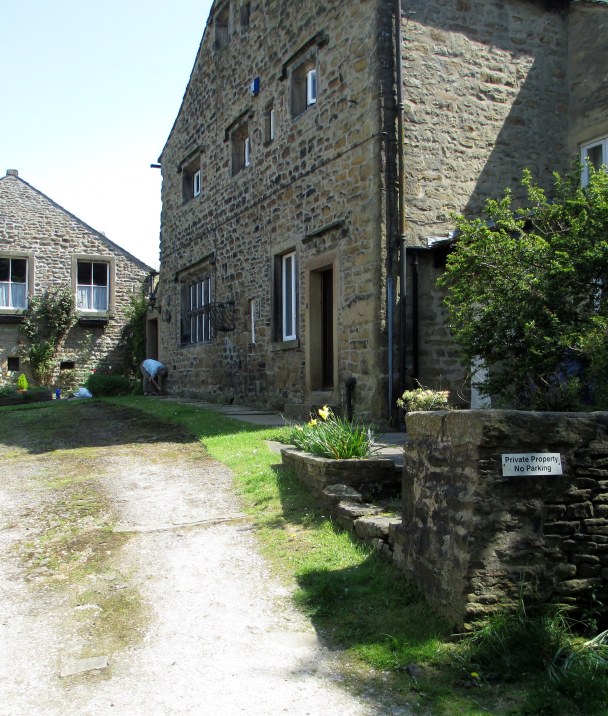
Viola weeding under her ‘shop’ window
I remember well being given a thrupenny bit and told to go to Auntie Vi’s and buy some teacakes or bread. Teacakes the like of which can’t be found any more, teacakes fit for giants, bread that had a proper crust and smelled of, well, freshly baked bread. I would run down the lanes to the footbridge over the beck, through the snicket and up to the kitchen window. When bread was for sale the kitchen window would be open and the bread sitting on a table inside. If Auntie Vi was there she would take the order, otherwise I would call for her and she would appear. Running this errand was worth it for the reward, Auntie Vi always gave me a fresh scone with currents, they were often warm, she would split the scone with a bone handled butter knife, smear it with a great dollop of butter from the local farm. As I walked back to the house with the teacakes in a bag I would nibble on the scone, savouring the currents as if they were fruits made in heaven.
We stood at a distance admiring the old house, me engrossed in the story. Rachel nudged me and pointed to an elderly lady who had appeared and was weeding in a garden underneath the ‘shop’ window. She wore an old hat tied under her chin with a floral ribbon and a pale blue shirt. Could this be Viola? I couldn’t resist and walked up the path to where she was working. The lady had turned, now with her back to us and was carefully weeding with intense concentration. I called out a ‘Hello’, but she didn’t turn. I called again with the same result. She must have been deaf, so we left her in peace and walked away hoping this was Great Auntie Viola.
Our final stop was Plum Tree Cottage across the beck. We stood by the garden wall, resting our arms on the rounded top stones. I noticed somebody stand up inside and frown at us, clearly wondering why we were staring at the house. The lady came to the door and we engaged her in conversation. Nearly 40 years on I found I was talking to one of my second cousins, Deborah. Her mother had inherited the cottage when Lilian died and Deborah was now happily continuing the family traditions. She said that Auntie Vi had died many years ago, but the memories didn’t die with her. How satisfying to rekindle the origin of such a fond memory.
Can you empathise with your garden?
As a parent of 4 grown humans I still thoroughly enjoy observing my children as they continue to evolve. The eldest, Rachel, is in her late 20’s and ever so gradually is assuming elements of responsibility associated with being the senior sibling. Everyone expects her to be wiser and understanding in all things family, this allows them to continue as members who enjoy the privileges without much responsibility for their actions within the group.
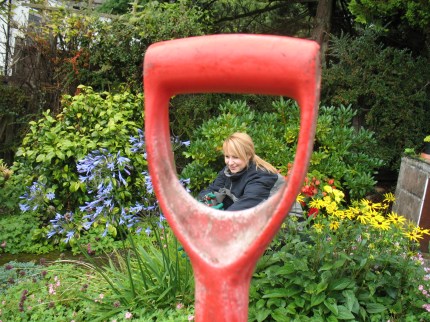
Who knows what mysteries lie in the eyes of a child?
I see my present role, professional gardener, in a similar way. Possibly, because I am physically older and supposedly wiser than Rachel, my role is more garden carer, a Foster Gardener.
Many new gardens that arrive into my care were established without much planning, have been allowed to become delinquent or ignored for many years and need intense nurturing to flourish. Recently some new properties appeared under my wing, I say appeared because I have no clue why the owners contacted me, nor does it matter to me. Suddenly I became responsible for numerous living things, and expected to care for them immediately. As I began to deal with these gardens I saw, for the first time, my role comparable to a foster parent.
On first inspection it excites me to see what is in a new garden. My experience quickly dictates what needs to be done to improve things. It seems too easy to say to the owner, ‘Rip it all up and start again.’ Implying that I have a magical formula, something that can only be nourished by the depth of their pockets. At first I prefer to work instinctively and see the value in what exists, to take the most obvious element (often near the front door) and get down on my hands and knees to see if the structure can be nurtured. It doesn’t take long for the owner to tune into my enthusiasm for their garden.
Structured gardening plans have long since been obliterated from my modus operandi, my instincts tell me when to feed a plant, my experience allows me to understand if a plant is healthy. Pruning to me is rather like cutting the fingernails of a child. The child is unlikely to bother about the length of a fingernail, only noticing if one is broken and becomes a nuisance, so responsible parents notice when the nail needs cutting to avoid potential problems. Plants can’t prune themselves to fit into our ethos of gardening (we attempt to control plants in an un-natural way). All gardens would naturally and quite quickly establish an order whereby unsuitable plants for position would cease to flourish. We act as plant zookeepers for our own edification and pruning allows these captive plants to at least enjoy their life in our care.
A happy garden reminds me of the sensations as you hold a cat and stroke it. The cat vibrates with unfettered delight and so does a garden when you look after it properly.
I now see all of my contract gardens as individuals who have to be cared for, encouraged to grow happily, but within the regime set down by the owner, a mutual regime that I implement and translate with lots of love and care. As an owner becomes familiar with my style they give me more freedom to choose what is best for the garden. When I first began contracting in Australia I needed the owners to guide me, they had to provide me with the ideas and I took their concepts and carried them out. Nowadays I seldom see the owners, they simply enjoy the fruits of my labour, I have become part of their garden and that suits me perfectly. Whenever I am among the plants I feel at home in their home.
It is rewarding to cherish a garden, every plant responds positively, just as humans respond to kindness and understanding. I am content to be a Foster Gardener, when I am in the garden, I am part of the garden, when I leave the garden it flourishes because I was there.
Life in Cairns was incredibly exciting after living on a coral island for 3 months. Being able to walk to a bus stop, get on a bus and travel to the next town felt like a massive injection of freedom. Leonie quickly found a job waitressing at a classy bistro down by the harbour working evenings so I had to forage the area on my own. Things were looking grim, but leaning on my ‘lemons to lemonade’ personality I devised a strategy.
We bought 2 ancient sit-up-and-beg bicycles cheaply at the Sunday market. With the sugar cane ripening the milling season about to get under way I cycled three times a week to the local mills. Eventually I secured a job at Gordonvale mill, Mulgrave, and started work hooking up the empty cane bins or operating the bin tippler which upended the cane bins onto a massive conveyor. Looking like bags on a luggage carousel the cane was transported into the bowels of the mill to be crushed and processed into sugar.
Of course this introduced me to sugar cane, a sort of monster grass that the region is famous for. Because of the tropical climate things grow at an awesome pace. Folk in the area must need to cut their lawns a couple of times a week. I would wander into the cane fields just to be in the midst of the cane, giant blades of swishing grass. Before modern cutting machinery the cane was cut by hand, one of the toughest jobs in the world, I spoke to people at the mill who could remember cutting cane by hand and it sounded a hideous job for little pay.
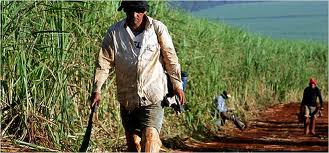
The mill had to be productive, which meant constant input of raw cane, slowing of the input meant drastic change for the engineers as they toiled to accommodate the flow. I rotated jobs with a couple of blokes, one hour hooking up bins, one hour off, then one hour operating the tippler. It didn’t take a lot of skill to seamlessly infiltrate the bin into the tippler, press a button and wait as the drum rolled tipping the cane onto the conveyor belt, press another button to return the bin upright and then press another button to shunt the bin out of the tippler. At least it didn’t seem like a lot of skill to me…arrogance of youth..
Night shift was a destroyer. It always felt good to go into work in the cooler evenings, meet up with the lads, have the craic and then take over from the previous shift. Seemless. By 1 or 2 a.m. the eyes began to droop and I hated my hour on the tippler, it was stuffy and uber noisy, cracking din of splintered cane being crushed. I always wanted to sleep then, instant, deep and soul satisfying sleep, sleep beckoned like the addict’s needle.
I did achieve Hall of Fame for Mill Idiots though. One night I was sitting at the console, pressing buttons and getting right into the zone, I was almost overfilling the conveyor in my mind making the bosses ecstaticly wealthy with my talent. Cocky so-and-so I managed to turn a full drum with one empty bin still exiting OMG! The adrenalin rush was overwhelming,, panic and fear surged up into my throat, dried out my tongue and prevented me from shouting ‘STOP THE MILL before the conveyor runs empty.’
I was not a popular bunny that night. The mill did stop for a few hours whilst the bin was disentangled, and I didn’t get any bonuses on pay day!
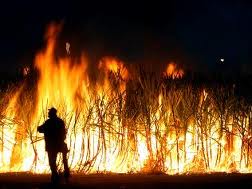
Picture credit Australian Daily Telegraph
Night shift became a challenge but was immensely rewarding, it allowed me to experience tropical nights with little distraction.
Outside of the building the vast night skies loomed, the Southern Sky spreadeagled to be seen in a profound and uplifting display. New stars and constellations had me thumbing through books and charts, each night I was eager to get in and identify more. As I sat at the console practising meditation I taught myself to become more tolerant and focused entirely on getting through that hour so that I could dash outside and feel the immensity of a pure night sky.
A tropical night is incredibly noisy, the air vibrant with life, swarms of insects and Australia’s great array of nocturnal creatures scurrying about their business. I suppose the noise of Cane Toads will stick with me most intensely. Brought in to control the rodent problems amongst the canefields, the toads themselves proliferated to such an extent that they are now the problem, no doubt the rodents survived and thrived as well.
Frank was the ‘unhooker’. As the cane bins came to the mill his job was to unhook the chains with a kind of boat hook on a pole. That was it, that was what Frank did, all night, every night. On my hour off I would frequently drift down to his station, seated on a stool as he unhooked the bins Frank would tell me tales of his life, how he was injured in a car accident and developed a distinctive limp, how he travelled from Tassie to the Tablelands to Cairns migrating with the seasonal work. Frank wasn’t highly educated but he was intuitive, a natural and his acute appreciation of the night was humbling. One night as he sat there telling me a convoluted tale of a journey from Sydney to Coober Pedy and a year he spent opal mining we both got a jolt. A massive snake was intertwined in the grill of a bin, it’s mouth protruding in strike pose. We both lurched backwards, Frank toppled off his stool, scrabbled on the floor ready to run, when we hit the door to his hut we turned and realised the snake was dead, some joker had fixed it up in the cane fields to give people a fright, it worked.
I sat with Frank and enjoyed a lunar eclipse. My memory doesn’t recall the detail too well, but I remember Frank explaining everything about the event. Cane burns were a regular feature of the night sky, the cane fields were torched in a controlled burn to remove much of the husk before it was cut. I once went with Frank to watch a burn, an unstoppable intensity with associated roar and flurry of escaping insects and wildlife that generated immense fear in me. Walsh’s Pyramid caught fire too. Walshs Pyramid (Bundadjarruga) (922 m) is an independent peak with a distinct pyramidal appearance, it’s the highest freestanding natural pyramid in the world. We watched the apocalyptic scene unfold for a few nights, as fires flared and smouldered along the steep flanks of the mountain, realising with trepidation that men were up there trying to stop the fires penetrate down to the properties. The thing about Frank was his ability to appreciate the space and magnificence of the world where he lived, I would often see him gazing up into the skies, arms resting on his knees with the unhooker casually cradled in his arms. I wondered often what went on in his mind as he stared into the vastness. Frank was special…Frank was killed in a car accident. I hadn’t felt such a loss before. Never had I expected to hold such powerful emotions for a man.
It’s the people we meet in life who make the experience so special.
 gardnslave's Blog